New York City
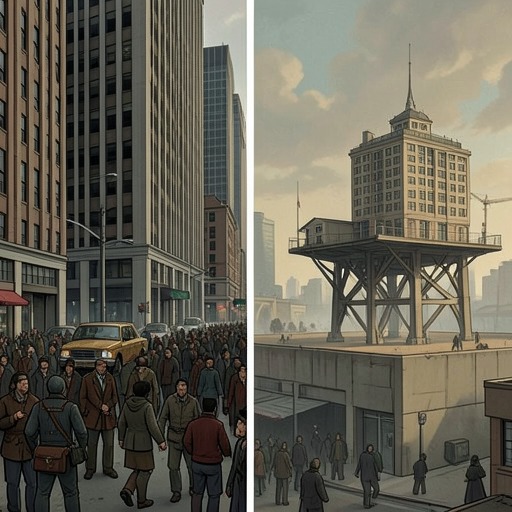
The Caves of SteelNew York City is both the setting of Elijah Baley’s life and an immense engineered habitat shaped by Earth’s population pressure. More than twenty million people live within its two thousand square miles; its tightly coordinated food systems, transport routes, residential Sections, and sealed steel-and-concrete structure embody the efficiencies that allow crowded Earth to function. Yet the city’s ordered design has a shadow: its motorways extend through a seemingly inexhaustible underground maze, while its yeast-fed kitchens and crowded public spaces make urban life a shared, standardized experience.
Scale and Historical Development
The modern New York City is only three centuries old, though a much older population center occupied the same geographical area for three thousand years. That earlier settlement was not a City in the modern sense. Across Earth, people had lived in thousands of open-air clusters, some reaching nearly ten million inhabitants, but these dispersed settlements were economically inefficient by the standards imposed by a growing population.
As Earth’s population increased from two billion to three billion and then five billion, living standards were progressively lowered to support it. At eight billion, however, the prospect of semistarvation made incremental adjustment inadequate. Earth’s culture had to change. Villages, towns, and old-style cities were gradually absorbed into the Cities; the force shield accelerated that consolidation after the prospect of atomic war had slowed it.
New York City is among the largest of the resulting urban systems: larger than every City except Los Angeles, and more populous than every City except Shanghai. At the last census it held well over twenty million people. It belongs to a network of roughly eight hundred Cities on Earth, each with an average population of ten million. These figures make the City not merely a large settlement but one component of a planetary response to population density and constrained resources.
The City as an Engineered Habitat
City culture organizes the distribution of food and intensifies the use of yeast and hydroponics. New York City is economically almost self-sufficient, able to roof itself in, gird itself about, and burrow itself under. The image of the City as a steel cave describes its enclosure and its scale: a self-contained environment built of steel and concrete, not an open settlement spread across the land.
Its layout is planned around function. A vast complex of administrative offices occupies the center. Large residential Sections are oriented in relation to one another and linked by expressways and local ways. Factories, hydroponic plants, yeast-culture vats, and power plants lie toward the outskirts. Water pipes and sewage ducts, schools, prisons, shops, power lines, and communication beams run throughout this organized fabric.
The Commissioner of Police, City of New York, works in a private office marked with Julius Enderby’s name on clouded glass. That modestly specific civic detail places the City’s police administration within the larger central apparatus: public authority, like residence and production, is housed inside the enclosed urban system.
Movement, Scale, and Hidden Spaces
The city’s motorways are so extensive that Baley wonders whether anyone still knows all the routes twisting through New York City’s depths. At any hour, the entire system is never empty, yet some individual passages may have gone unused for years. The contrast is characteristic of the urban environment: continuous movement across the network coexists with pockets of near-total abandonment.
That hidden geography brings to mind a story Baley encountered as a boy about the motorways of London. In it, a murderer seeks refuge in a corner of an abandoned motorway where his footprints have been the only disturbance for a century, but a wrong turn traps him in a vast, unending maze. The remembered tale gives the City’s infrastructure a double aspect: its routes are built for efficient circulation, but their scale can exceed any one person’s knowledge and turn a practical network into a disorienting labyrinth.
The City’s internal distances are also managed through routine transit. Baley’s movement toward the Newark Section is governed by timing: he must leave the moving route, work down a ramp, pass through standing passengers, follow a railing, and cross decelerating strips. Such details show how travel through the City depends on carefully coordinated paths and bodily adaptation to crowded flows, rather than on open streets.
Shared Routines and Urban Culture
The City’s food system shapes ordinary meals as well as the larger economy. Section kitchens are alike across New York City and in cities Baley has visited, including Washington, Toronto, Los Angeles, London, and Budapest. Yeast products are broadly standardized across the continents, from Shanghai to Tashkent and from Winnipeg to Buenos Aires; English, too, has become a shared contemporary mixture, with some variation on the Outer Worlds.
The kitchens share more than menus and language. Their characteristic odor, waiting triple line, converging entrance, and division into right, left, and center streams give them a recognizable common form. Inside, the rumble of people speaking and moving is punctuated by the sharper clatter of plastic against plastic; simulated wood, polished surfaces, glass, and steam complete the repeated setting. These public dining rooms express the logic of City culture in miniature: instead of duplicating kitchens in every home, the system concentrates meals in efficient communal facilities.
The standardized kitchen stands in contrast to the older practice of maintaining separate kitchens and bathrooms in every dwelling. What might appear to be an intimate domestic convenience is treated as an inefficient duplication when measured against shared diners and shower rooms. New York City’s culture therefore reaches beyond its buildings and transport: it reorganizes domestic habits around common services and uniform provision.
Population Pressure and the Spacer Contrast
The City’s efficiency does not resolve Earth’s underlying crisis. Even with its food systems and tightly coordinated infrastructure, the growing population may eventually drive available calories per person below basic subsistence. New York City represents a powerful adaptation to crowding, but not a permanent escape from the limits that made that adaptation necessary.
The pressure is sharpened by comparison with the Spacers, descendants of early emigrants from Earth who live on underpopulated, robot-ridden worlds. They preserve the comfort made possible by low population density, keep their birth rate down, and bar immigrants from crowded Earth. Spacetown’s arrival makes that distant political and social contrast immediate within the City’s world: the sealed urban habitat and the spacious Spacer societies stand for competing responses to population, comfort, and access.
New York City is consequently both an achievement and a constraint. Its scale, engineered self-sufficiency, and shared routines sustain a dense population, while its enclosed form and complex passages make the built environment an all-encompassing condition of life. The City’s success is real, but it remains bounded by the same population pressure that produced it.